
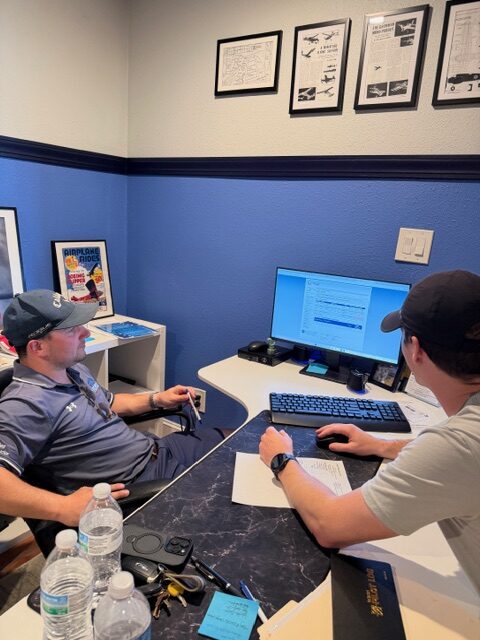
At Coastal Skies, we believe that great pilots are built through consistent training, honest evaluation, and strong preparation. One of the most important tools we use to help students succeed is the stage check process.
A stage check is an oral assessment and evaluation flight conducted by one of our designated check instructors. These evaluations are designed to ensure that students are progressing safely, confidently, and efficiently through their training. While they can feel intimidating at first, stage checks are one of the most valuable parts of the learning process—and the results speak for themselves.
What is a Stage Check?
A stage check is essentially a progress evaluation that takes place at key milestones during training. Unlike regular lessons with your primary instructor, stage checks are conducted by a different instructor who provides an objective assessment of the students’ knowledge, critical thinking, decision making, and piloting ability.
This outside perspective helps identify strengths, uncover weaknesses, and ensure every student meets the standards required before advancing to the next phase of training.
Our stage check structure includes:
Private Pilot Training
- Pre-Solo Stage Check
- Solo Cross Country Stage Check
- Mock Checkride
Instrument Rating Training
- Mid-course Stage Check
- Mock Checkride
Commercial, CFI, and CFII Training
- Mock Checkride
Each stage check is tailored to the specific certificate, rating, or endorsement sought and focuses on preparing students for real-world flying and FAA standards.
Why Stage Checks Are Important
1. They improve safety
Aviation is built on standards and accountability. Stage checks ensure students are truly ready before moving forward in training.
For example, before a student completes their first solo flight, we want confirmation from both their instructor and an unbiased check instructor that they can safely and confidently operate the aircraft on their own. The same principle applies before solo cross-country flights and the practical tests.
These evaluations create an additional layer of safety and quality control that benefits everyone.
2. They Prepare Students for the Checkride Environment
One of the biggest challenges students face during an FAA practical test is simply dealing with the pressure of being evaluated by someone unfamiliar.
Stage checks help students become comfortable demonstrating their skills to an unfamiliar (or at least less familiar than their primary instructor) evaluator in a professional setting. This way, by the time students reach the checkride, they have already experienced:
- Oral questioning
- Scenario-based evaluations
- Performance standards
- The pressure of a formal evaluation
This dramatically reduces checkride anxiety and improves overall performance.
3. They Create Consistency Across Training
Every instructor has a unique teaching style, and that diversity is valuable. However, stage checks ensure that all students are being trained to the same standard regardless of which instructor(s) they regularly fly with.
Each of our check instructors provide consistency by evaluating students against clear expectations and FAA Airman Certification Standards (ACS). This helps maintain a high level of training quality across all programs.
4. They Help Identify Weak Areas Early
Sometimes students unknowingly develop bad habits or struggle in certain areas without realizing it. A fresh set of eyes can often catch issues that can be corrected before they become larger problems.
Stage checks allow us to identify:
- Knowledge gaps
- Procedural weaknesses
- Communication issues
- Decision making errors
- Areas requiring additional repetition
Addressing these items earlier in training leads to better long-term outcomes and more confident pilots.
5. They Build Confidence
Many students initially view stage checks as obstacles, but most leave them feeling more confident than before.
Successfully completing a stage check confirms that the student is progressing appropriately and meeting standards. Even when the desired outcome is not achieved and additional work is needed, students receive focused feedback that gives them a clear path forward.
By the time students reach their checkride, they know they have already proven themselves multiple times throughout training.
What we are Actually Looking For in Stage Checks
One of the biggest misconceptions about stage checks is that we expect perfection. We don’t. The same is true during a checkride.
A stage check is not about flying like an airline captain with 20,000 hours. It’s about demonstrating that you can operate safely, think critically, make sound aeronautical decisions, and perform to an acceptable standard for your level of training.
As check instructors, we are primarily evaluating four things:
- Safety
- Aeronautical Decision Making (ADM)
- Critical Thinking Skills
- FAA ACS Standards
Safety always comes first. A student who makes a small procedural mistake, but recognizes it, corrects it, and continues operating safely is showing us far more than someone who tries to force perfect flying while losing situational awareness.
We also pay close attention to decision making. Can you recognize changing conditions? Can you prioritize tasks? Can you identify and correct mistakes before they become unsafe? Aviation is full of imperfect situations, and good pilots are defined more by how they respond than by never making errors at all.
Of course, the FAA Airman Certification Standards (ACS) are still the benchmark. We use those standards as the foundation for evaluating maneuvers and procedures. However, stage checks are not conducted with a robotic “one-strike-and-you’re-out” mentality.
There is some reasonable leniency built into the evaluation process. If a student briefly exceeds an ACS tolerance but recognizes it and corrects it in a timely manner, that alone is usually not grounds for failure. The key is demonstrating awareness, correction, and control.
For example, if altitude drifts 120 feet high during steep turns but the student promptly corrects back within standards, that tells us the student is actively monitoring the aircraft and managing deviations appropriately. On the other hand, repeated deviations throughout the flight with little recognition or correction may indicate a larger proficiency issue and will likely lead to an unsatisfactory outcome.
What we are ultimately trying to determine is this:
“Is this student operating safely and consistently enough to move forward in training?” That is the real purpose of a stage check. Not perfection, rather proficiency, judgment, and safety.
The Results Speak for Themselves
Since implementing our structured stage check program, we have seen a significant increase in our checkride pass rates.
That improvement is not accidental.
Students arrive at their practical tests better prepared, more polished, and more confident because they have already been evaluated multiple times throughout training. They know what to expect, understand the standards, and have had opportunities to correct deficiencies before the checkride.
The stage check process also strengthens communication between instructors and helps ensure students are consistently receiving high-quality training from day one through checkride completion.
A Commitment to Excellence
Our goal is not simply to help students pass a test. Our mission is to develop safe, competent, and confident pilots who are prepared for real-world flying.
Stage checks are one of the ways we uphold that commitment.
While they may add an extra step to the training process, they ultimately save students time, reduce setbacks, improve pass rates, and most importantly, produce stronger aviators.
In aviation, preparation matters—and stage checks are a key part in that preparation.
“Luck is when preparation meets opportunity” -Darrell Royal